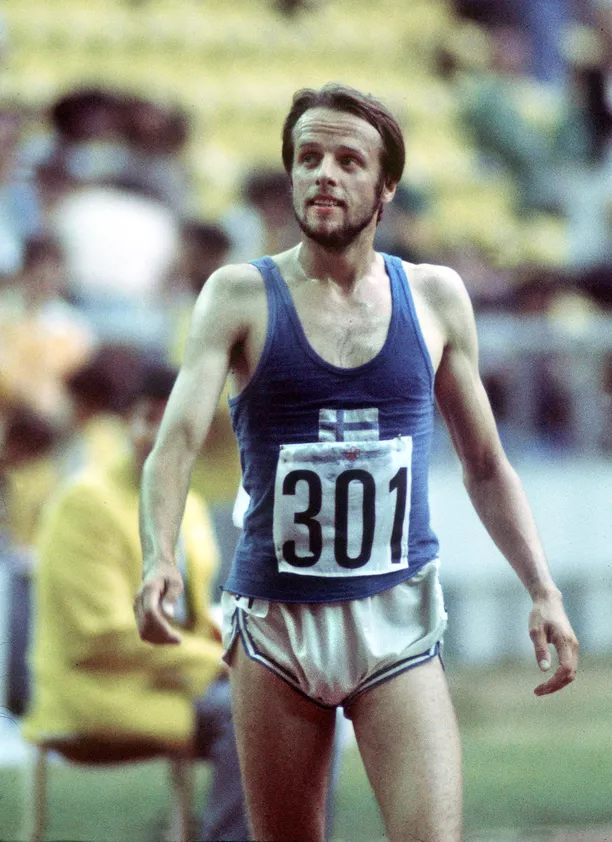
In the annals of sports history, there are athletes who transcend their own achievements to become iconic figures, forever etching their names in the collective memory of their nation and the world. Lasse Viren, the legendary Finnish distance runner, is undoubtedly one of those figures. In the 1970s, Viren not only redefined what it meant to be a distance runner but also singlehandedly recaptured the image of the "Flying Finn," a title that had been synonymous with Finnish athletic excellence in the early 20th century.
How Lasse Viren Recaptured the Image of the Flying Finn
Virén began his running career in the United States at Brigham Young University, in Provo, Utah. Virén ran on the Varsity Cross-Country team for BYU for one season, before returning home to his native Finland.
A police officer from Myrskylä, Virén debuted on the international scene in 1971. His performances at the 1971 European Championships in Helsinki were overshadowed by fellow Finn Juha Väätäinen, who captured gold medals in both the 5000 and 10,000 metres events with Virén settling for modest seventh and 17th placings, respectively. According to Virén himself and his coach, Rolf Haikkola, Virén could have placed better in the 1971 European Athletics Championships, if he had done the "emptying exercise" of his system earlier – according to Haikkola, he followed the Finnish Athletics Federation's leaders' bad advice – and if he hadn't been pushed almost to the point of falling at the start of the last lap in the 5000 metres final. The "emptying exercise" of top runners means that they push their bodies to a total exhaustion or lack of energy so that their bodies can again receive much energy, and so that they can repeat their top race performances. Shortly after those European Championships, he broke Väätäinen's fresh Finnish record at 5,000 metres.
Buoyed by a brutal training regimen in Thomson's Falls, Kenya, and very impressive results, which included the smashing of the 2-mile world record and wins against Great Britain and Spain in a meet held in Helsinki in the summer of 1972, Lasse Virén entered the Munich Games as a dark horse.
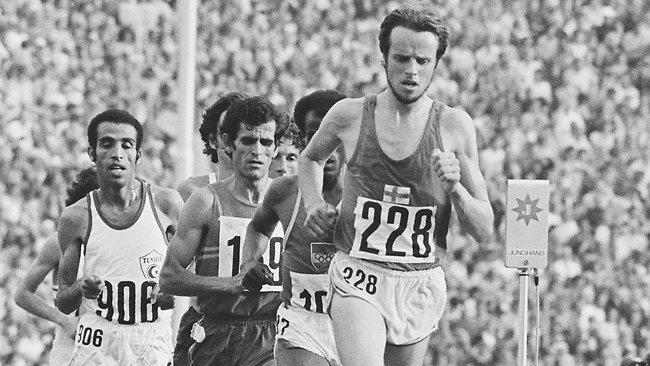
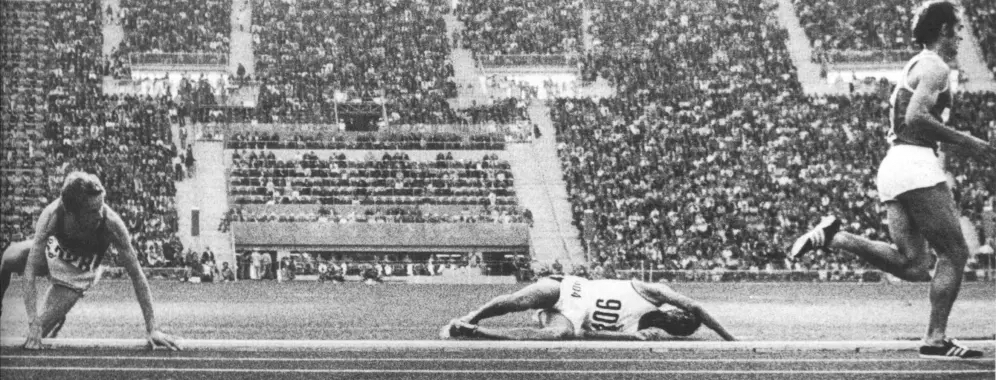
At the 1972 Summer Olympics at Munich, Virén won both the 5,000 and the 10,000 metres events. At the 10,000 metres final held on 3 September, Virén broke Ron Clarke's 7-year-old world record despite falling in the twelfth lap after getting tangled with Emiel Puttemans. Mohamed Gammoudi also fell after being tripped by Virén's legs. In less than 150 metres, Virén caught up with the leading pack after losing about 20 metres. With 600 metres to go, Virén started an unprecedented lap-and-a-half kick to which only Puttemans was able to respond. The Finn won the race in 27:38:40 (which is still the current record for the Olympiastadion).
Virén became the fourth athlete to win both events in the same Olympics, joining fellow Finn Hannes Kolehmainen (1912), Czechoslovakia's Emil Zátopek (1952) and Russian Vladimir Kuts (1956). After them, Miruts Yifter (1980) and Kenenisa Bekele (2008), both from Ethiopia, and Mo Farah from Great Britain (2012 and 2016), accomplished the coveted "double". However, only Kolehmainen, Virén and Yifter had to endure 10,000 metres heats to qualify for the 10,000 metres final. In the 5,000-metres final one week later, Viren could keep up with Steve Prefontaine, Gammoudi, Puttemans and Ian Stewart, in the race's quick final four laps. He sprinted past Gammoudi with around 110 to 120 metres to go, and won in 13:26.4, one second before Gammoudi. Four days later, despite the wet, chilly and windy weather in the Helsinki Olympic Stadium, he set a new world record at 5,000 metres by running 13:16.4. Six days later, Puttemans broke the record by roughly three seconds.
One factor in Virén's Olympic victories, especially at the 1972 Olympics 5,000 and 10,000 metres, has received little attention: his careful running of almost all the bends (curves) near the inner edge of the first lane, which spared him tens of metres compared to his chief rivals. More specifically, Steve Prefontaine gave Virén an advantage of more than forty metres over 5,000 m in 1972, while Emiel Puttemans gave about fifty metres over 10,000 m, by running many bends wide on the outer edge of the first lane or sometimes even on the second lane. This metre-saving practice is called "bend (curve) mathematics".
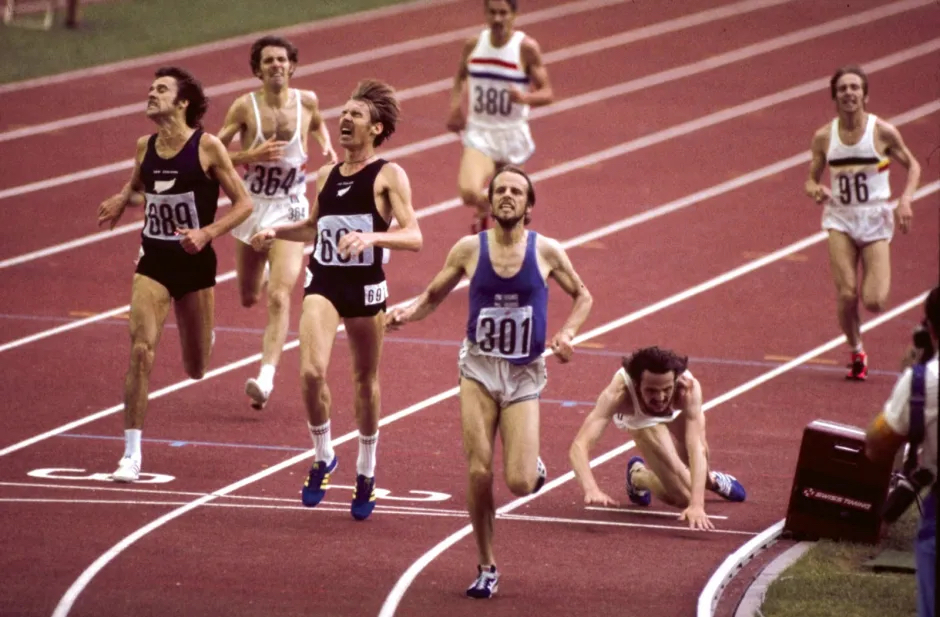
Virén ran at lower levels between the Olympics. At the 1976 Summer Olympics, Virén again won both events, coined later as the "double double", and became the first repeat winner of the 5,000 metres race in Olympic history (since joined by Mo Farah). He won the 10,000-metre final comparatively easily, because even Great Britain's Brendan Foster dropped from the steadily accelerating pace of Portugal's Carlos Lopes at 8,000 metres, and because Lopes back then was unable to radically increase his pace in the last lap or so of track races. Virén passed Lopes at around 9,550 metres and defeated him by 4.79 seconds.
Following his 10,000 metres final win at the Montreal games, he took off his Onitsuka Tiger (ASICS) Runspark shoes and waved them to the crowd on his victory lap. The International Olympic Committee accused Virén of malicious intent, such as showing the tiger stripe logo on the shoes, but he claimed that he had a blister. Thus, the IOC suspended Virén from taking place in the 5,000-metres final after qualifying in his heat. An appeal followed and he was allowed to enter the race, two hours before gun time.
In the 5,000 metres final, he held off all-time greats Dick Quax, Rod Dixon and Brendan Foster (all world-class at 1,500 m) with a devastating display of front-running over the last few laps. To those who watched him, the display was awesomely inspiring to the point that his last 1,500 metres in that final would have placed him 8th in the 1,500-metres final held at those Games. The top four runners sprinted to the finish line inside six metres, a rare occurrence in major international championships. He competed in the men's marathon, his first marathon and finished fifth in 2:13:11.
Lasse Viren's remarkable career serves as a testament to the indomitable human spirit, and his ability to recapture the spirit of the "Flying Finn" is a story of dedication, innovation, and the pursuit of excellence. His achievements continue to inspire new generations of runners and reinforce the legacy of the Flying Finn in the rich tapestry of sports history.